
1. Introduction: Beyond Blended Learning
In recent years, Blended Learning has gained significant attention in education. It is frequently mentioned in government policy documents, funding applications, and institutional strategies. The term refers to a teaching approach that combines traditional face-to-face instruction with online learning activities. While the idea of blending different learning methods is appealing, there is a major challenge: blended learning lacks a universally accepted definition and clear pedagogical guidelines. This ambiguity has led to confusion among educators, policymakers, and institutions. As a result, its implementation varies widely, often without a consistent or effective approach.
Many educators and institutions have adopted blended learning because it seems modern and flexible. However, without a structured framework, it can become little more than a mix of online and in-person activities, without a clear focus on how or why these elements are combined. This can lead to superficial integration, where technology is used simply for the sake of using it, rather than to enhance learning outcomes.
Flipped Learning 3.0 (FL3) addresses these shortcomings by providing a structured, purpose-driven framework for designing education. Unlike blended learning, which primarily describes how learning is delivered (a mix of online and face-to-face), FL3 focuses on why and how learning should be designed to achieve meaningful outcomes. It shifts the conversation from merely combining formats to intentionally creating learning experiences that are active, learner-centred, and aligned with clear educational goals.
2. What is Flipped Learning 3.0?
Imagine walking into a classroom where students aren’t just passively listening to a lecture—they’re actively discussing, solving problems, and applying what they’ve learned. That’s the spirit of Flipped Learning 3.0 (FL3), but it’s so much more than just a teaching technique. It’s a thoughtful, structured way of designing education that puts learners at the heart of the process.
FL3 was developed by Jon Bergmann, one of the pioneers of the flipped classroom movement. The original flipped classroom idea—where students engage with content at home (like watching videos) and use class time for practice—was a great start. But over time, educators realised that simply moving lectures online wasn’t enough. Without clear guidance, the approach could feel disjointed or even superficial—just “homework before class” without deeper purpose.
That’s where FL3 comes in. It takes the best of the flipped classroom and adds structure, pedagogy, and clarity. It’s not just about what students do, but why and how they do it. FL3 provides educators with a framework for intentional design, ensuring that every activity—whether online or in person—has a meaningful role in the learning journey.
At its core, FL3 is not just a method. It’s a way of thinking about education that prioritises active engagement, clear learning goals, and a seamless blend of technology and human interaction. It’s about creating an environment where students don’t just consume information—they explore, question, and grow.
This FL3 framework is a roadmap for meaningful learning, helping teachers move beyond simply mixing online and face-to-face activities to crafting experiences that truly resonate with learners.
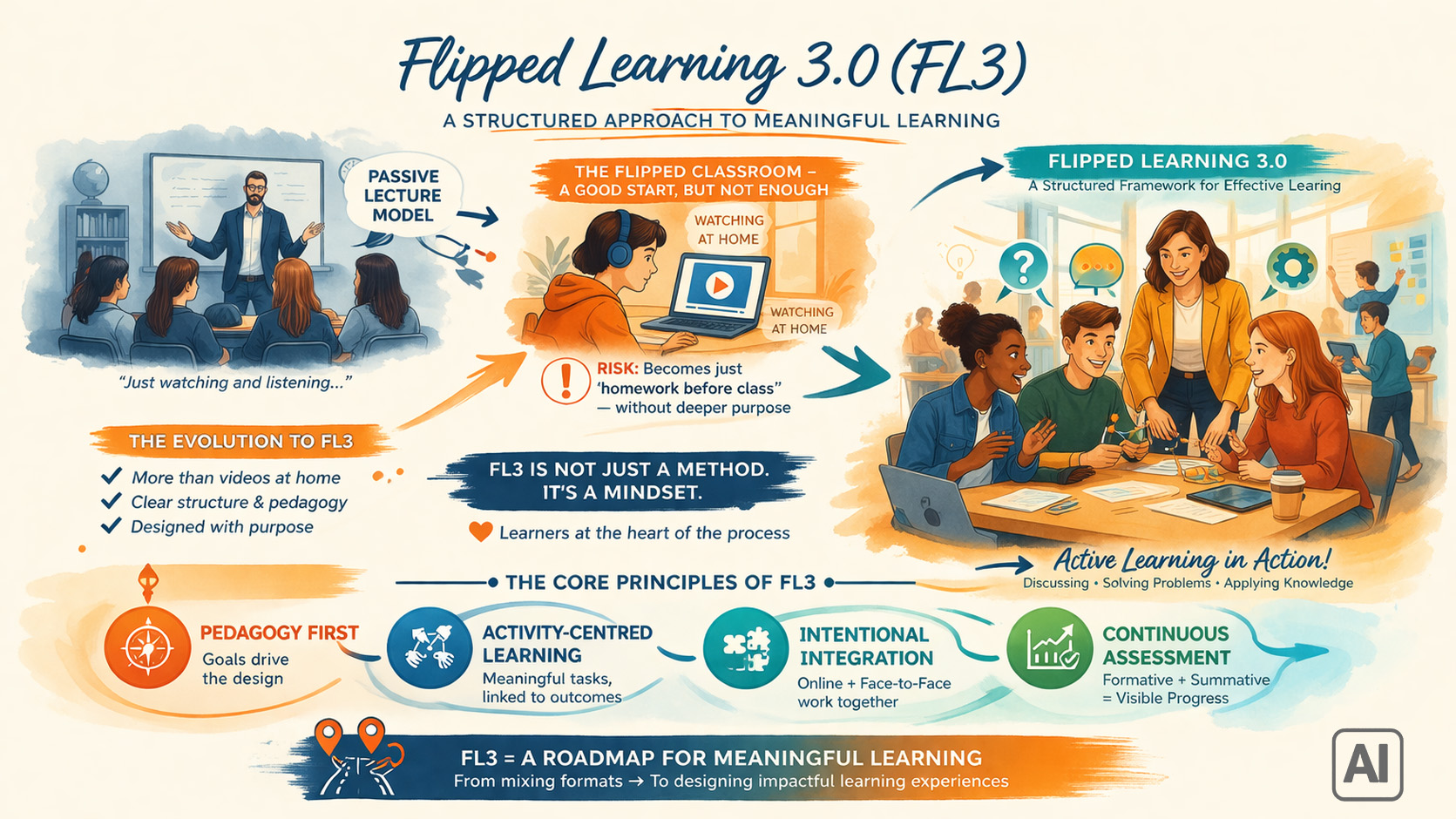
3. From Flipped Classroom to Flipped Learning 3.0
The flipped classroom was just the beginning—here’s how Flipped Learning 3.0 transforms a simple idea into a powerful, purpose-driven approach to education.
3.1 The Traditional Flipped Classroom
The traditional flipped classroom model emerged as a refreshing alternative to the age-old lecture-based approach. Instead of spending class time delivering content—where students passively listen and take notes—teachers began assigning pre-class activities, such as watching instructional videos, reading texts, or completing short online modules. The idea was simple yet revolutionary: free up valuable in-person time for interaction, collaboration, and hands-on practice.
At first glance, this shift made perfect sense. Students could engage with foundational material at their own pace, pausing and revisiting concepts as needed. Meanwhile, classroom sessions became dynamic spaces for discussions, problem-solving, group work, and personalised feedback. This approach naturally encouraged active learning, as students were no longer just recipients of information but active participants in their own education.
However, as educators began implementing the flipped classroom, they encountered a critical realisation: the model alone did not guarantee depth or meaningful learning. While it successfully moved direct instruction outside the classroom, it often stopped short of ensuring that the in-class activities were purposefully designed, well-structured, or aligned with clear learning outcomes.
Common Challenges in the Traditional Model
-
Superficial Engagement with Content
- Students might watch videos or read materials at home, but without guided reflection or application tasks, their understanding could remain surface-level.
- Some learners struggled with self-regulated learning, leading to uneven preparation—where a few came to class fully prepared, while others arrived confused or unprepared.
-
Lack of Pedagogical Structure
- The flipped classroom focused on where learning happened (home vs. class) rather than how it should unfold.
- Without a framework to guide the design of in-class activities, some lessons became disorganised or unfocused, missing opportunities for deeper exploration.
-
Over-Reliance on Videos
- The model became closely associated with pre-recorded lectures, leading to the misconception that “flipped learning” was just about watching videos at home.
- While videos can be useful, they are only one tool among many—and not always the most effective for every learner or subject.
-
Limited Integration of Assessment and Feedback
- Traditional flipped classrooms often lacked systematic ways to assess understanding before, during, and after class.
- Without ongoing feedback loops, teachers couldn’t easily identify gaps in knowledge or adjust instruction in real time.
The Need for Evolution
The traditional flipped classroom was a valuable first step—it challenged the status quo and showed the potential of rethinking how time and space are used in education. But it also highlighted the need for something more: a framework that doesn’t just flip the where of learning, but transforms the how and why. This is where Flipped Learning 3.0 enters the picture, offering the structure, pedagogy, and intentionality that the original model lacked.
3.2 Why an Extended Framework Was Needed
Teaching is rarely straightforward. Even the most promising ideas can fall flat without the right support structure behind them. That is exactly what happened with the early flipped classroom model. The concept was exciting — and for good reason. But excitement alone does not make something work in practice.
The problem was not the idea itself. The problem was the lack of guidance around it. Teachers were told, in essence, to move the lecture out of the classroom and fill the freed-up time with something more active. But what, exactly? And how? There were no clear answers. So naturally, many educators did what they could with what they had. Some produced videos and hoped for the best. Others pieced together activities without a clear sense of purpose. The result, in many cases, was a flipped classroom that looked different on the surface but felt much the same underneath.
Students noticed too. Watching a video at home instead of listening to a lecture in class is, at its core, still a passive experience. If nothing meaningfully changes in how students are expected to think, question, or engage — then very little has actually been flipped. The location of the content had moved. The quality of the learning, however, had not necessarily improved.
There was also the issue of consistency. Without shared principles, two teachers both claiming to use the flipped classroom could be doing something entirely different. One might design thoughtful, well-sequenced pre-class tasks linked to rich in-class discussions. Another might simply upload a YouTube video and call it done. Both would be described using the same term, which made it very difficult to evaluate whether the approach was actually working — or to share good practice across schools and institutions.
This is precisely why a more developed framework was needed. Not to overcomplicate things, but to give educators a shared language and a clear set of principles to work from. FL3 was built to fill that gap. It takes the original flipped classroom idea and asks deeper questions: What is the purpose of the pre-class activity? How does it connect to what happens in the room? How do we know whether students are genuinely learning, rather than simply going through the motions?
By grounding the approach in solid pedagogy, FL3 turns a good instinct into a reliable method. It gives teachers the confidence to design learning experiences that are intentional, coherent, and genuinely centred on the student — rather than just technically “flipped”.
4. Core Principles of Flipped Learning 3.0
It moves the discussion away from tools and formats and brings the focus back to what really matters: how learning is designed and experienced.
Flipped Learning 3.0 is not defined by videos, platforms, or schedules. It is defined by a small number of clear principles that guide every design decision. These principles help educators create learning environments that are purposeful, coherent, and effective.
Rather than asking “Which tool should I use?”, FL3 encourages a different question:
“What kind of learning experience do I want to create?” This shift may seem small, but it changes everything. It moves teaching away from content delivery and towards intentional learning design.
4.1 Pedagogy First
What should learners understand, be able to do, or reflect on by the end of the learning process?
This may sound obvious, but in practice it is often overlooked. Too many courses begin with technology — choosing a platform, creating videos, or uploading materials — without a clear pedagogical direction.
FL3 takes the opposite approach. The design starts with clear learning objectives, and all other elements follow from this.
Technology still plays an important role, but it supports the learning process rather than shaping it. It is a tool, not a driver.
This shift ensures that learning remains meaningful and focused, rather than becoming a collection of disconnected activities.
4.2 Activity-Centred Learning
Flipped Learning 3.0 places strong emphasis on what learners actually do. Learning is not seen as the passive reception of information, but as an active process.
This means that tasks and activities are at the centre of the design. They are not add-ons or optional extras — they are the core of learning.
Effective activities in FL3 are:
- active rather than passive
- meaningful rather than repetitive
- clearly linked to learning outcomes
For example, instead of simply watching an interactive video, learners might analyse a case, solve a problem, or discuss different perspectives with others. The aim is to create situations where learners engage with the content, apply their knowledge, and reflect on their understanding. In this way, learning becomes something that learners experience, not something that is simply delivered to them.
4.3 Intentional Integration
A key feature of Flipped Learning 3.0 is the deliberate connection between online and face-to-face elements. In many blended learning scenarios, these components exist side by side but are not truly connected. Online materials are added, and classroom sessions continue as before. The result is often fragmented and unclear.
FL3 avoids this by focusing on intentional integration. Each part of the learning process has a clear role and purpose.
- The Individual Learning Space (ILS) prepares learners for deeper work.
- The Group Learning Space (GLS) builds on this preparation through interaction, discussion, and application.
These elements are not separate. They are designed to support each other in a structured way. This creates a coherent learning journey, where each step makes sense and contributes to the overall learning goals.
4.4 Continuous Assessment
In Flipped Learning 3.0, learning is made visible throughout the process. Assessment is not something that only happens at the end. It is an ongoing part of the learning experience.
FL3 combines both formative and summative assessment:
- Formative assessment supports learning during the process.
It provides feedback, helps learners reflect, and allows adjustments along the way. - Summative assessment evaluates what has been achieved.
It confirms whether the learning goals have been met.
This continuous approach has several advantages. Learners receive regular feedback, which helps them stay on track. Educators gain insight into progress and can adapt their teaching if needed. Most importantly, assessment becomes part of learning — not just a way of measuring it.
5. Key Components of the FL3 Framework
A framework is only as good as its parts. FL3 works because each of its components serves a clear purpose — and because those components are designed to work together, not in isolation. Understanding how they fit helps educators move beyond guesswork and towards genuinely purposeful design.
5.1 Individual Learning Phase (Individual Learning Space, ILS)
Before students ever set foot in the classroom, learning has already begun. This is the individual learning phase — the part of FL3 that most people recognise from the original flipped classroom model. But in FL3, it goes further than simply assigning a video to watch the night before.
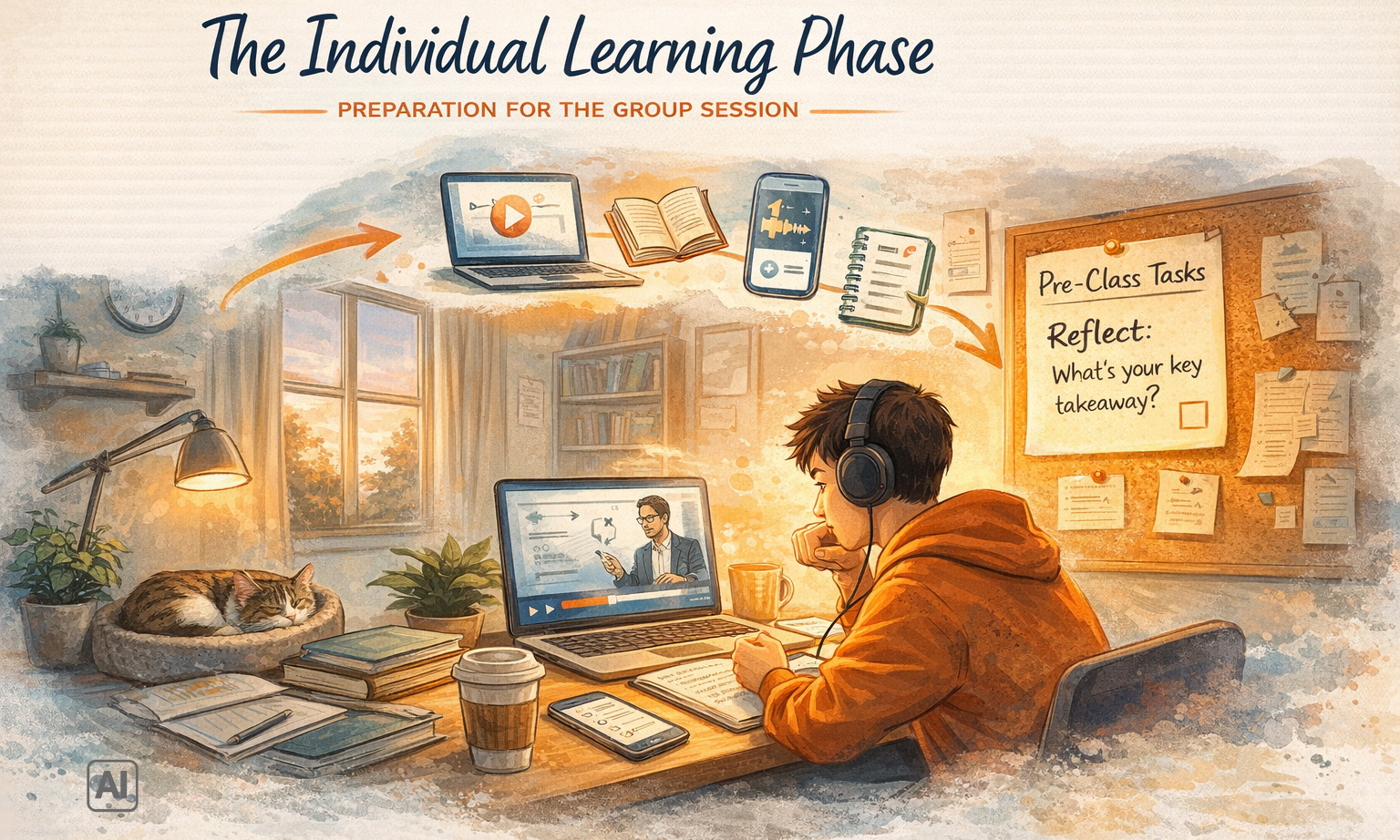
The individual learning space is about giving students the time and space to encounter new content on their own terms. That might mean watching a short video, reading a carefully chosen text, completing a microlearning module, or listening to a podcast. The format matters less than the intention behind it. What is important is that the material is accessible, focused, and manageable — something a student can genuinely engage with independently, without a teacher standing next to them.
Because students learn at different speeds and in different ways, this phase naturally accommodates a level of flexibility that a traditional lecture simply cannot. A student who needs to re-read a passage three times can do so. A student who grasps the concept quickly can move on. This is not about leaving learners to fend for themselves — it is about respecting the fact that the first encounter with new material does not need to happen in a group setting.
Crucially, this phase should never feel disconnected from what comes next. In FL3, pre-class tasks are designed with the group session clearly in mind. Students are not just consuming content — they are preparing to use it. A short reflection prompt or a simple question at the end of a video can make all the difference, giving learners something concrete to bring into the room with them.
5.2 Group Learning Space
If the individual phase is about encountering ideas, the group learning space is where those ideas come alive. This is the heart of the FL3 classroom — the place where students stop receiving information and start doing something with it.
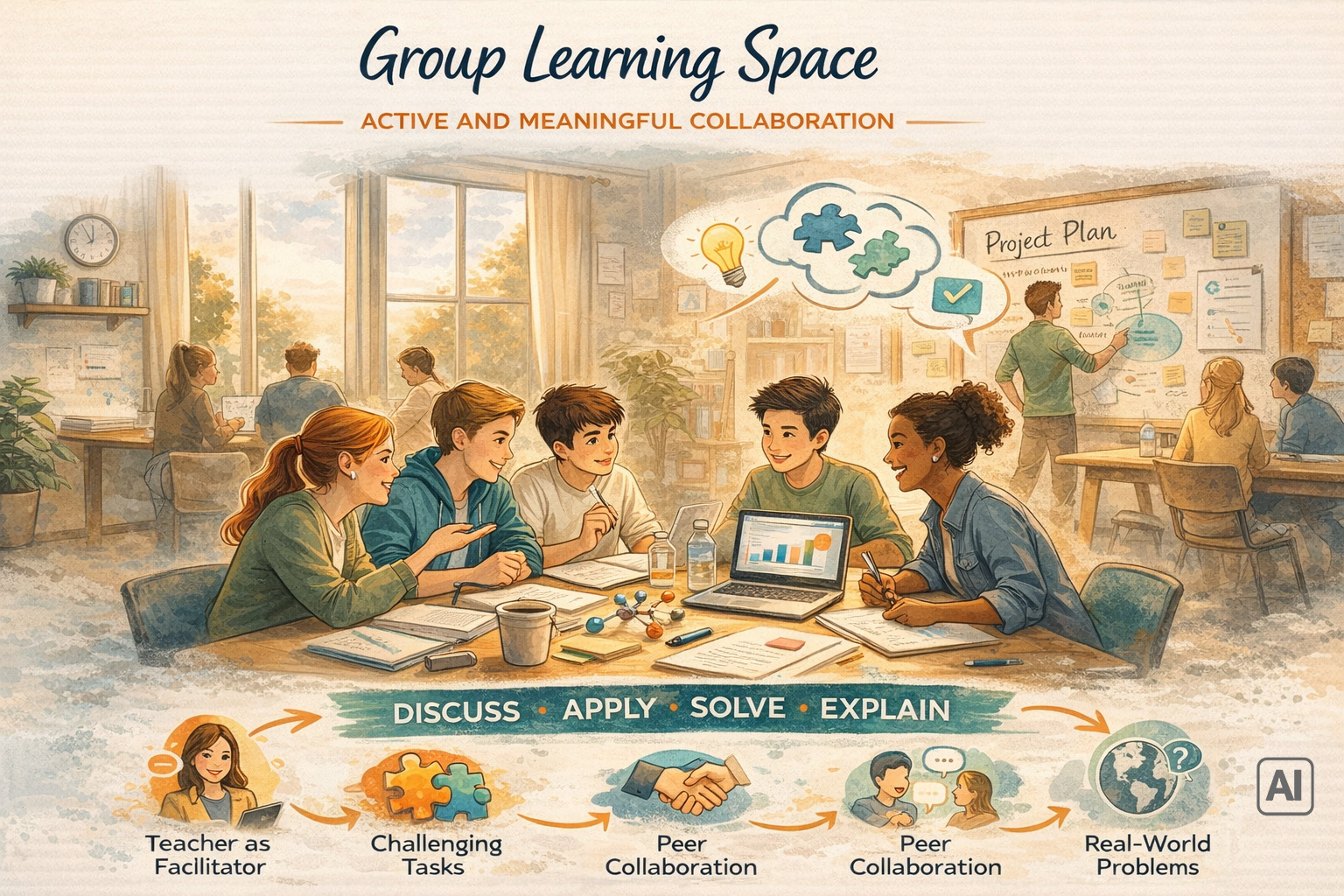
Because the foundational content has already been covered before class, the teacher is no longer under pressure to stand at the front and explain everything from scratch. That time is now free for something far more valuable: genuine interaction. Students can discuss, debate, compare their thinking, work through problems together, and challenge each other’s understanding in ways that a lecture simply does not allow.
The teacher’s role shifts here too. Rather than being the primary source of information, the teacher becomes a facilitator — moving around the room, listening in on conversations, asking probing questions, and stepping in where support is needed. This is where a skilled educator can make a real difference, not by delivering content to everyone at once, but by responding to what individual students and groups actually need at that moment.
Deep learning tends to happen when students are asked to apply what they know, explain it to someone else, or use it to solve a problem they have not seen before. The group learning space is designed to create exactly those conditions. It is active, social, and purposeful — and it is what separates FL3 from a model that simply moves the lecture online.
5.3 Learning Cycle
Underpinning both phases is a simple but powerful structure: the FL3 learning cycle. Every unit, topic, or lesson follows the same four steps — input, activity, reflection, and feedback — and it is this cycle that gives the whole framework its coherence.
Input is where new knowledge is introduced. This typically happens during the individual learning phase, through whatever materials the teacher has prepared or selected. It sets the foundation for everything that follows.
Activity is where students put that knowledge to work. In the group learning space, they apply, discuss, experiment, and explore. The activity is not an add-on — it is the point. Without it, input alone rarely leads to genuine understanding.
Reflection is perhaps the most underestimated step. Giving students time to pause and consider what they have learned — what made sense, what surprised them, what still feels unclear — helps move knowledge from short-term memory into something more lasting. Even a few minutes of structured reflection can have a meaningful impact on retention.
Feedback closes the loop. It tells students how they are doing and gives teachers the information they need to adjust what comes next. In FL3, feedback is not reserved for end-of-term assessments. It is woven throughout the process — informal, timely, and genuinely useful.
Together, these four steps create a rhythm that students can come to rely on. When learning feels structured and predictable in this way, it becomes easier to engage with — and easier to build on. Each cycle prepares the ground for the next, supporting not just retention of individual topics, but the gradual transfer of knowledge and skills over time.
6. The Role of Blended Learning within FL3
There is a tendency in education to treat blended learning as though it were a method in itself — a solution to be implemented, a strategy to be rolled out. But this misunderstands what blended learning actually is. At its most honest, blended learning simply describes how content is delivered: some of it online, some of it face-to-face. It tells us about the format. It says very little about the quality, the purpose, or the design of the learning itself.
This distinction matters more than it might first appear. A course can be thoroughly blended — with online videos, digital quizzes, and in-person sessions — and still be deeply ineffective. The blending of formats does not, on its own, produce better learning. What produces better learning is thoughtful design: knowing why each element is there, how it connects to the rest, and what students are expected to do with it.
This is exactly where FL3 comes in.
Rather than replacing blended learning, FL3 gives it a backbone. It provides the design logic that blended delivery on its own lacks. The individual learning phase — where students engage with videos, readings, or digital modules before class — is, in practical terms, a blended element. So is the use of online tools for reflection tasks, peer feedback, or formative assessment. FL3 does not avoid these things. It simply ensures they are used with intention rather than habit.
Think of it this way. Blended learning is the vehicle. FL3 is the route map. You can have a perfectly good vehicle and still end up going nowhere in particular — or somewhere you never intended. The route map does not replace the vehicle, but without it, the journey lacks direction.
This means that blended learning is best understood as a component within FL3, not as a framework of its own. It is one of the tools the FL3 designer reaches for — useful, flexible, and often essential — but always in service of a larger pedagogical purpose. The question is never simply “shall we blend?” The question is “how does this blend serve the learner, and where does it fit in the learning cycle?”
For educators and institutions, this reframing has practical consequences. It means that investing in online platforms, video content, or digital assessment tools is only worthwhile if there is a clear framework guiding how those tools are used. Technology without pedagogy is expensive decoration. FL3 ensures that every blended element earns its place — contributing to a coherent experience rather than adding noise to an already crowded learning environment.
7. Advantages of Flipped Learning 3.0
Every teaching approach makes promises. The real question is whether it keeps them. FL3 is not without its demands — it asks more of educators in the planning stage, and it requires a genuine shift in how both teachers and students think about their roles. But when it is implemented thoughtfully, the benefits are substantial and felt across the entire learning experience.
A Clear Structure for Educators
One of the most immediate advantages of FL3 is simply that it gives teachers something to hold on to. Education is full of well-meaning ideas that arrive without guidance — concepts that sound promising in a staff meeting but leave teachers wondering, on a practical level, what to actually do on Monday morning.
FL3 is different. The learning cycle — input, activity, reflection, feedback — provides a reliable structure that can be applied across subjects, year groups, and contexts. Teachers do not need to reinvent the wheel for every unit. They have a consistent design logic to work from, which frees up mental energy for the parts of teaching that truly require creativity and judgement. New teachers find it easier to get started. Experienced teachers find it easier to refine and improve. Both benefit from having a shared language they can use when collaborating with colleagues.
A Strong Pedagogical Foundation
FL3 is not built on instinct or trend. It draws on well-established research into how people learn — including work on active learning, cognitive load, retrieval practice, and the importance of feedback. This gives the framework a credibility that many popular educational ideas lack.
For educators who have always sensed that passive instruction was not working as well as it should, FL3 offers something reassuring: evidence that there is a better way, and a structured method for putting it into practice. For institutions and policymakers, it offers a defensible, research-informed approach that goes well beyond surface-level innovation. It is not just a new idea — it is a better-grounded one.
Supporting Active and Visible Learning
Perhaps the most important advantage of FL3 is what it does for students in the room. Because foundational content is encountered before class, in-person time is freed up for the kind of learning that actually requires other people — discussion, collaboration, problem-solving, and hands-on application. Students are no longer passive recipients sitting in rows. They are thinking, talking, questioning, and doing.
This shift also makes learning visible in a way that traditional teaching rarely achieves. When students are actively working through a problem or explaining an idea to a peer, a teacher can see — in real time — who understands, who is struggling, and where the gaps are. Learning stops being a private, invisible process that only becomes apparent at the end of a term. It becomes something that can be observed, responded to, and shaped as it happens.
Improving Evaluation and Quality Assurance
Because FL3 embeds reflection and feedback into every learning cycle, evaluation is no longer something that happens at the end. It is built into the process from the start. Teachers gather ongoing information about student progress — through check-in tasks, in-class observation, and structured reflection — which means they can adjust their approach while there is still time to make a difference.
For institutions, this has clear benefits too. FL3 creates natural points for quality assurance — moments where learning design can be reviewed, compared, and improved. Because the framework is consistent and transparent, it is far easier to identify what is working and what is not. Rather than relying on end-of-year results or student satisfaction surveys alone, educators and leaders have a richer, more continuous picture of how learning is actually unfolding. That is not just good for students — it is good for the long-term health of any educational institution.
8. Implications for Practice
Understanding FL3 is one thing. Putting it into practice is another. The framework does not implement itself — it requires people at every level of an educational system to think and work differently. For some, that is a significant shift. For others, it builds naturally on what they already do well. Either way, the implications are worth considering carefully.
8.1 For Educators
The most fundamental shift that FL3 asks of teachers is a change in identity. Not a dramatic one — but a real one nonetheless. In a traditional model, the teacher is primarily a deliverer of content. In FL3, that role expands into something richer and, arguably, more demanding: the teacher becomes a learning designer.
This means that planning looks different. Rather than asking “what do I need to cover today?”, the FL3 educator asks “what do I want students to be able to do by the end of this unit — and how do I design an experience that gets them there?” The focus shifts from content coverage to learning outcomes. From delivery to design.
In practice, this involves thinking carefully about what students need to encounter before class, what they should be doing during it, and how feedback will be built into the process at every stage. It requires more upfront planning, yes — but it also makes in-class time feel far more purposeful and, for many teachers, far more rewarding. When students arrive prepared and engaged, and when classroom time is genuinely active, teaching stops feeling like a performance and starts feeling like a genuine exchange.
FL3 also asks teachers to become comfortable stepping back. Not disappearing — but shifting from the front of the room to the spaces in between, where the real conversations happen.
8.2 For Institutions
For schools, colleges, and universities, FL3 offers something that is genuinely difficult to find in education: a framework that is both principled and practical. Institutions are often caught between the pressure to innovate and the risk of adopting ideas that sound impressive but deliver little. FL3 cuts through that tension.
By providing a consistent design logic, FL3 helps institutions move beyond the language of buzzwords — beyond “blended learning”, “student-centred approaches”, and “21st century skills” — and towards something more concrete. When a whole institution, or even a whole department, works within the same framework, it becomes possible to have meaningful conversations about quality. Teachers can share resources and strategies. Leaders can observe lessons with a shared set of expectations. Professional development becomes more focused and more useful.
This consistency also matters when it comes to accountability. Institutions are increasingly expected to demonstrate not just that learning is happening, but that it is happening well. FL3 creates the conditions for that kind of transparency — because its structure makes the design of learning visible, reviewable, and improvable over time. It is not a guarantee of quality, but it is a foundation on which quality can be built and sustained.
8.3 For Projects — Such as Erasmus+
International education projects bring their own particular challenges. Partners come from different countries, different systems, and different teaching traditions. What counts as “active learning” in one context may look quite different in another. Without a shared framework, collaboration can quickly become superficial — a series of meetings and deliverables that never quite add up to something coherent.
FL3 addresses this directly. Because it provides a clear, transferable design logic, it gives international partners a common language and a common reference point. A teacher in Austria and a teacher in Portugal may work in very different classrooms, with very different students — but if both are designing within the FL3 framework, they are working from the same principles. That makes genuine comparison possible. It makes shared materials more usable. And it makes the outcomes of a project far easier to document, evaluate, and build on.
For Erasmus+ projects in particular, where comparability and transferability across partners are not just desirable but often required, FL3 offers a practical and credible foundation. It transforms collaboration from a matter of goodwill and coordination into something with real pedagogical substance — which is, ultimately, what these projects are there to achieve.
9. Challenges and Considerations
No framework, however well-designed, comes without its difficulties. FL3 is a genuinely powerful approach — but it would be dishonest to present it without acknowledging the real challenges that come with putting it into practice. Understanding these challenges is not a reason to avoid FL3. It is a reason to approach it with open eyes.
Training and a Shift in Mindset
Perhaps the most significant challenge is also the least visible one. FL3 does not just ask teachers to learn new techniques — it asks them to think differently about what teaching actually is. For educators who have spent years, or even decades, at the front of a classroom delivering content, that is not a small ask. It touches on professional identity, on deeply held beliefs about what good teaching looks like, and on habits that have become second nature.
This is why training alone is rarely enough. A one-day workshop on FL3 can introduce the concepts, but it cannot, on its own, produce the kind of mindset shift the framework requires. Real change takes time, support, and — crucially — space to experiment and make mistakes without fear. Institutions that want to implement FL3 meaningfully need to invest not just in professional development, but in the culture around it. Teachers need colleagues to learn with, leaders who model the approach, and enough psychological safety to try something new and reflect honestly on how it went.
Without that environment, even the most enthusiastic early adopters can find themselves reverting to familiar patterns under pressure.
Time for Design and Planning
FL3 demands more from the planning stage than traditional teaching typically does. Designing a well-sequenced individual learning phase, building purposeful in-class activities, and embedding feedback throughout a learning cycle takes time — and time is the one resource that most educators feel they have least of.
This is a genuine tension, and it should not be brushed aside. In the short term, moving to FL3 can feel like an additional burden on top of an already full workload. Pre-class materials need to be found, adapted, or created. In-class tasks need to be designed with clear outcomes in mind. The learning cycle needs to be thought through as a whole, not assembled at the last minute.
The honest answer is that the upfront investment is real — but so is the return. Teachers who have worked within FL3 for a sustained period often report that planning becomes more efficient over time, as the design logic becomes more intuitive and materials are refined and reused. The difficulty is getting through the early stages without burning out. Institutions have a responsibility here: to protect planning time, encourage collaboration, and resist the temptation to demand full implementation overnight.
The Risk of Reduction
Of all the challenges facing FL3, perhaps the most insidious is the risk of oversimplification. It has happened before. The original flipped classroom was a nuanced idea that, in many hands, gradually narrowed into a single practice: record a video, assign it for homework, and call it flipped. The richness of the original concept was lost, and with it, much of the potential benefit.
FL3 faces the same risk. Without ongoing support and a genuine understanding of the framework, there is a very real danger that it gets reduced, over time, to its most surface-level interpretation — students watching videos at home, teachers feeling they have done their part. The structure, the learning cycle, the intentional design: all of it can quietly disappear, leaving behind only the shell of the idea.
Guarding against this requires more than good intentions. It requires regular reflection on practice, honest evaluation of whether the framework is genuinely being applied, and a willingness to ask uncomfortable questions about whether the learning experience has truly changed — or whether only the packaging has.
FL3 is worth the effort. But it only delivers on its promise when it is taken seriously, implemented with care, and treated as an ongoing commitment rather than a one-time initiative.
Flipped Learning 3.0 is a powerful framework for modern education. It brings clarity, structure, and purpose to blended formats — and helps educators focus on what really matters: learning.
