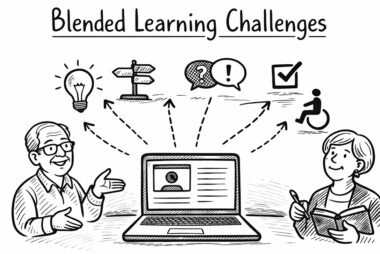
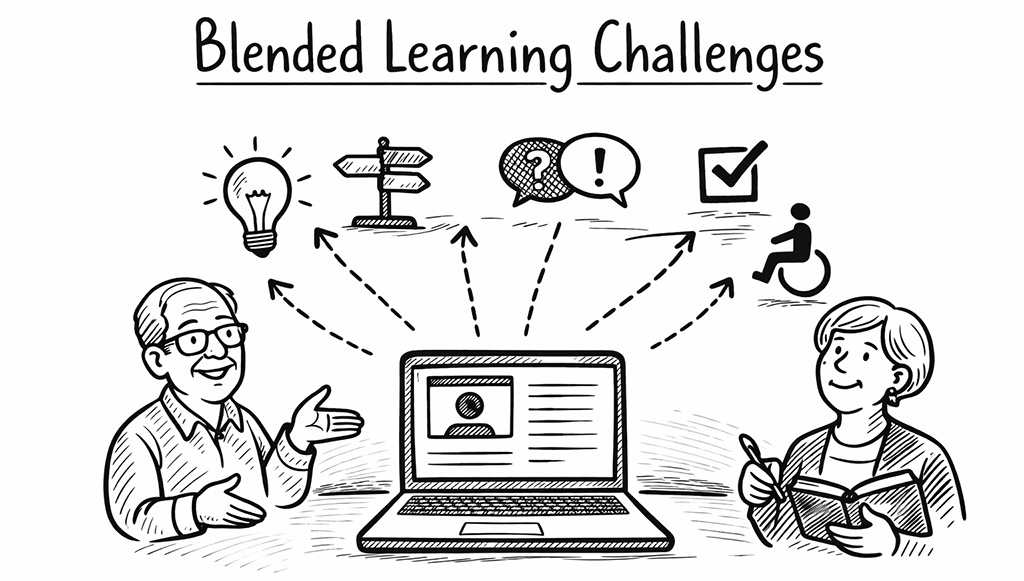
Blended Learning has become one of the most widely used terms in education. At its core, it simply describes a mix of face-to-face and online learning (Sometimes the question arises asking the difference between Blended – Flipped Learning).
This sounds useful — and it is.
However, the concept often remains quite broad. Different educators interpret it in different ways. For some, it means adding digital content to a traditional course. For others, it involves a more integrated learning design.
As a result, Blended Learning offers flexibility, but not always clear guidance.
What about Flipped Learning?
Flipped Learning 3.0 takes a different approach. It is not just about mixing formats. It is a structured framework for designing learning.
In Flipped Learning 3.0, learners first engage with new content individually. This often happens through videos or digital materials. Face-to-face time is then used for active learning, collaboration, and more profound understanding.
More importantly, Flipped Learning 3.0 is based on clear principles. It focuses on learning activities, interaction, and meaningful assessment. It provides guidance on how to design learning experiences — not just how to deliver content.
This is the key difference
Blended Learning describes what is combined. Flipped Learning 3.0 explains how and why learning should be designed.
In this sense, blended learning is not replaced by Flipped Learning 3.0. It is included within it.
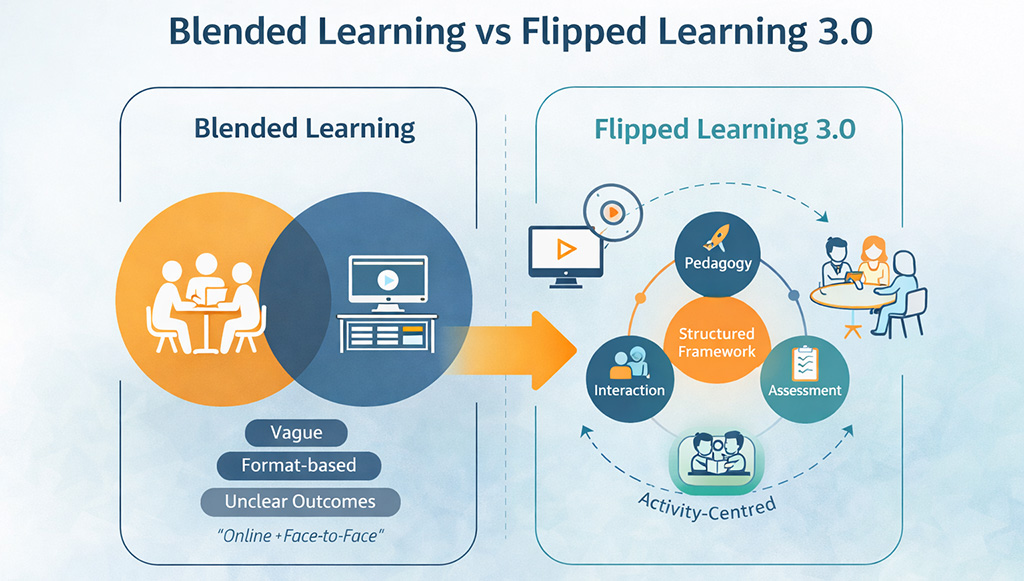
Blended Learning becomes one element of a broader, structured framework — a tool that is used purposefully within Flipped Learning 3.0 to support effective and meaningful learning.
A more detailed description of Blended Learning can be found from this web page.