For many years, Blended Learning(1) has been presented as the future of education. Universities, schools, companies, and adult education providers have invested heavily in online platforms, digital learning materials, and virtual classrooms. During the COVID-19 pandemic, blended learning became almost unavoidable, and today it has become a standard delivery method in many educational settings.
But an important question remains:
Does simply combining classroom teaching with online learning automatically improve education?
The answer is no.
Blended Learning can offer remarkable advantages, but only when it is carefully designed and supported by good educational practice. If it is implemented poorly, it may create more problems than benefits.
What is Blended Learning?
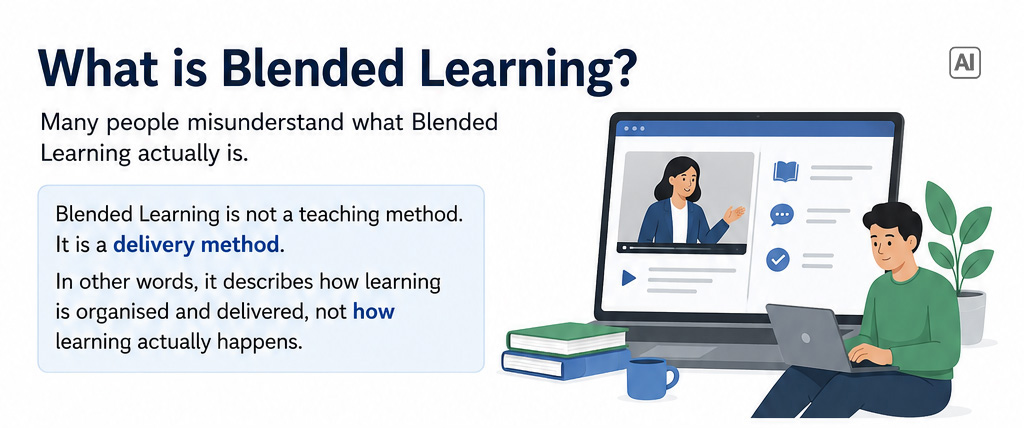
Many people misunderstand what Blended Learning actually is.
Blended Learning is not a teaching method. It is a delivery method. In other words, it describes how learning is organised and delivered, not how learning actually happens.
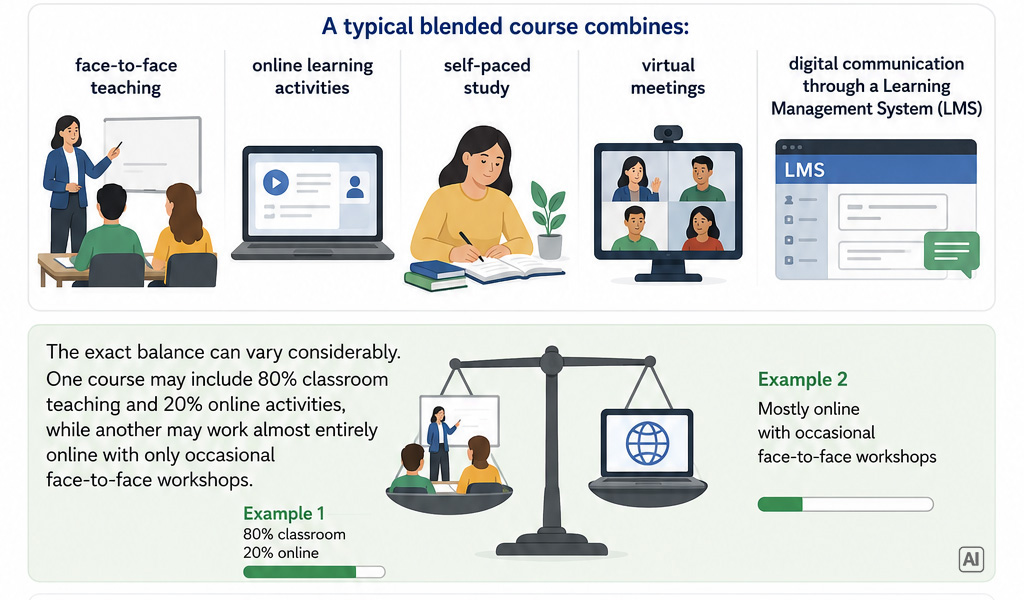
A typical blended course combines:
- face-to-face teaching
- online learning activities
- self-paced study
- virtual meetings
- digital communication through a Learning Management System (LMS)
The exact balance can vary considerably. One course may include 80% classroom teaching and 20% online activities, while another may work almost entirely online with only occasional face-to-face workshops.
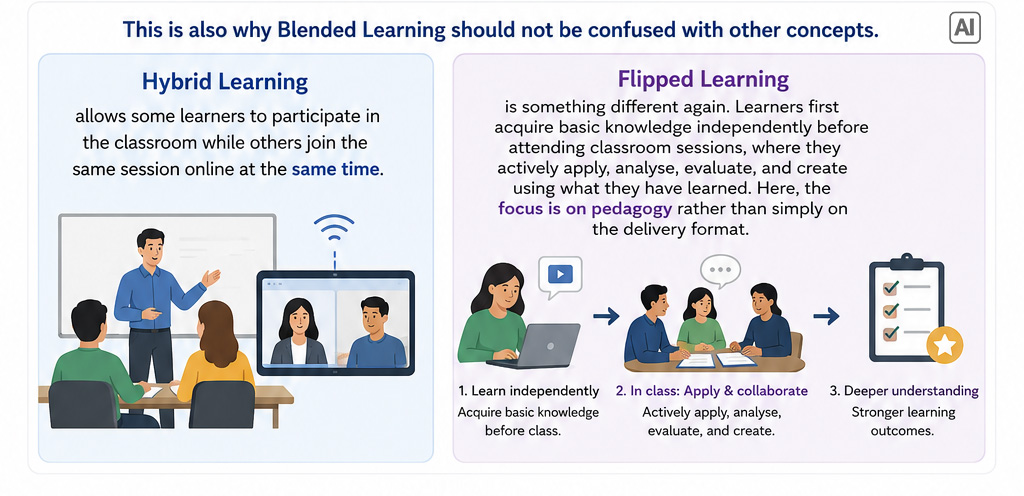
This is also why Blended Learning should not be confused with other concepts.
Hybrid Learning allows some learners to participate in the classroom while others join the same session online at the same time.
Flipped Learning is something different again. Learners first acquire basic knowledge independently before attending classroom sessions, where they actively apply, analyse, evaluate, and create using what they have learned. Here, the focus is on pedagogy rather than simply on the delivery format.
Why Blended Learning Became So Popular
Several developments have made Blended Learning increasingly attractive.
Modern learning platforms such as Moodle, Canvas and Blackboard have become more user-friendly. Video conferencing tools allow people to collaborate from almost anywhere. Digital content can be reused and updated more easily than traditional printed materials. At the same time, many learners expect greater flexibility because they combine education with work, family responsibilities, or long commuting distances.
For organisations, Blended Learning also promises lower travel costs, better scalability, and more efficient use of learning resources.
These are strong arguments—but they tell only part of the story.
The Challenges That Are Often Ignored
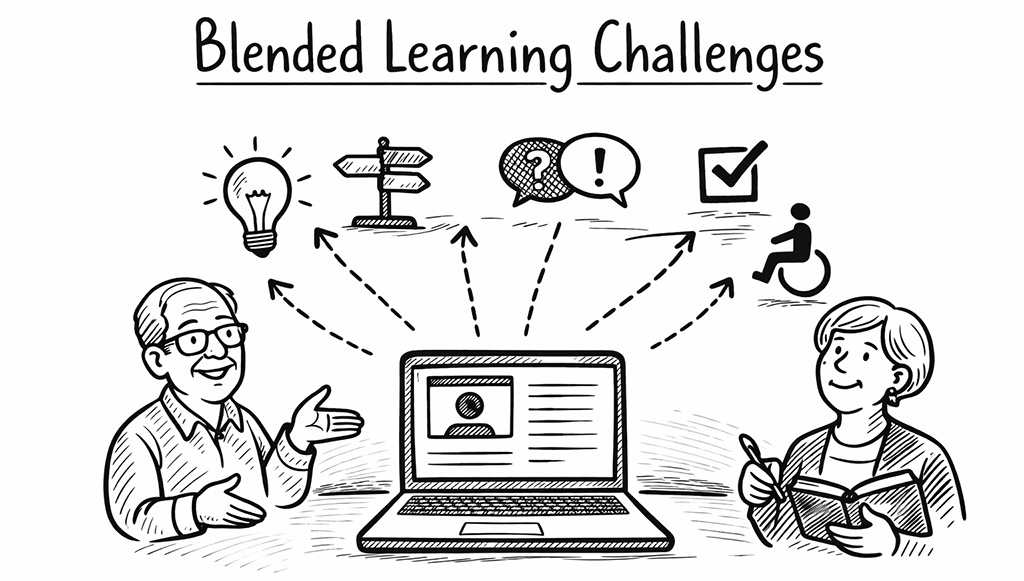
Despite its popularity, Blended Learning faces several significant challenges.
Digital Skills Cannot Be Taken for Granted
Many educators still receive little training in digital pedagogy.
Knowing how to operate Zoom or upload a PDF to Moodle does not automatically mean someone can design effective online learning.
Likewise, learners may struggle with unfamiliar technologies, poor internet connections, or limited digital confidence.
Successful Blended Learning depends on continuous support for both educators and learners.
Technology Is Not Equally Available
Not everyone owns a modern computer.
Not everyone has fast broadband.
Not everyone has a quiet place to study.
These differences create a digital divide that can increase educational inequality instead of reducing it.
Institutions therefore need strategies such as loan devices, flexible access options, and technical support services.
Online Learning Can Feel Isolating
Human interaction remains one of the strongest motivators in education.
When learners study alone for long periods, motivation often decreases.
Without active community building, discussion forums frequently become inactive, group work disappears, and learners begin to feel disconnected.
Successful blended courses deliberately create opportunities for communication, collaboration, mentoring, and peer support.
Learning is still a social activity.
Too Much Choice Can Become a Problem
Personalisation is valuable.
Too many options are not.
When learners face dozens of resources without clear guidance, decision fatigue can quickly appear.
Well-designed learning pathways help learners understand:
- where to start
- what is essential
- what is optional
- how activities connect
- how success will be measured
Clear structure often increases confidence.
Passive Online Learning
Perhaps the most common mistake is assuming that watching videos equals learning. Simply replacing classroom lectures with recorded lectures rarely improves educational quality. Active learning remains essential.
Good online learning should include regular opportunities to:
- answer questions
- solve problems
- discuss ideas
- reflect
- receive feedback
- apply knowledge
Learning happens through thinking—not through watching.
Quality Depends on Design
One of the biggest misunderstandings is that Blended Learning automatically improves education.
It does not.
Many courses are little more than traditional classroom teaching supported by uploaded PowerPoint slides and PDF documents. This is not effective blended learning.
High-quality Blended Learning requires:
- clearly defined learning outcomes
- thoughtful instructional design
- meaningful online activities
- appropriate assessment
- continuous feedback
- regular course evaluation
International quality frameworks such as the Quality Matters Rubric have shown that systematic quality standards significantly improve online and blended learning environments.
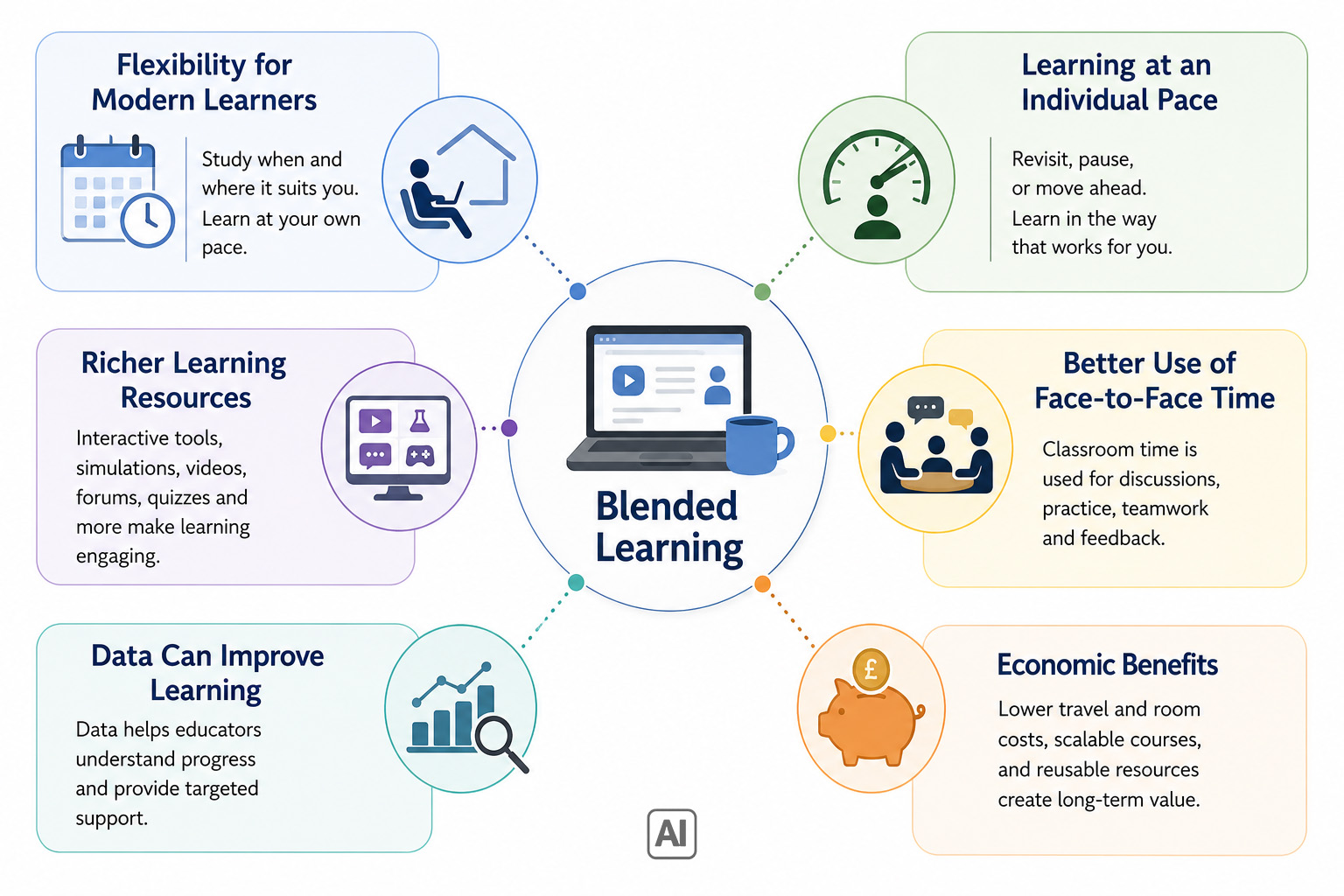
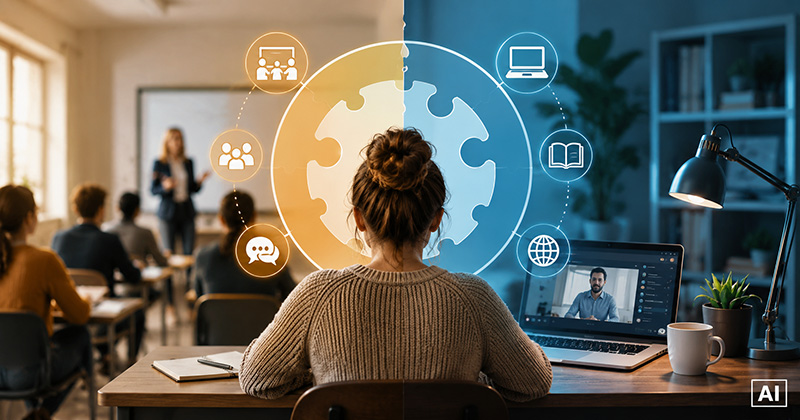
This visualisation summarises some advantages of the Blended Learning approach.
When Does Blended Learning Work Best?
Blended Learning is particularly successful when learners need flexibility while still benefiting from personal interaction.
It works especially well in:
- adult education
- professional development
- workplace learning
- higher education
- language learning
- compliance training
- lifelong learning
It is less suitable when extensive practical training is required, such as nursing, construction, or many vocational trades, where hands-on experience remains essential.
Likewise, learners with limited digital skills or low self-motivation may require additional support before blended learning becomes truly effective.
Looking Beyond Blended Learning
Today, educational research increasingly emphasises that delivery methods alone do not determine learning success.
The real question is no longer:
“Should we use Blended Learning?”
Instead, educators ask:
“How can we design learning experiences that actively engage learners?”
This shift explains why approaches such as Flipped Learning, competency-based education, active learning, and learner-centred instructional design receive growing attention.
The technology delivers the learning.
The pedagogy creates the learning.
These are two very different things.
Final Thoughts
Blended Learning remains one of the most important developments in modern education. It offers flexibility, wider access, and many opportunities to improve learning experiences.
However, it is not a universal solution.
Technology alone cannot replace good teaching.
Successful Blended Learning requires clear learning objectives, well-designed learning activities, competent educators, reliable technology, strong learner support, and continuous quality improvement. The future of education will not be determined by how much technology we use. It will be determined by how wisely we combine technology with sound educational principles and meaningful human interaction.
As educational researcher Neil Selwyn has repeatedly argued, technology does not solve educational problems by itself. Likewise, the influential meta-analysis by Means and colleagues for the U.S. Department of Education showed that blended learning often produces slightly better learning outcomes than purely online or purely classroom-based teaching—but largely because of the improved instructional design that frequently accompanies it, not simply because technology has been added.
That may be the most important lesson of all.
(1) See: https://www.digitallearninginstitute.com/blog/what-is-blended-learning-definition-benefits-models